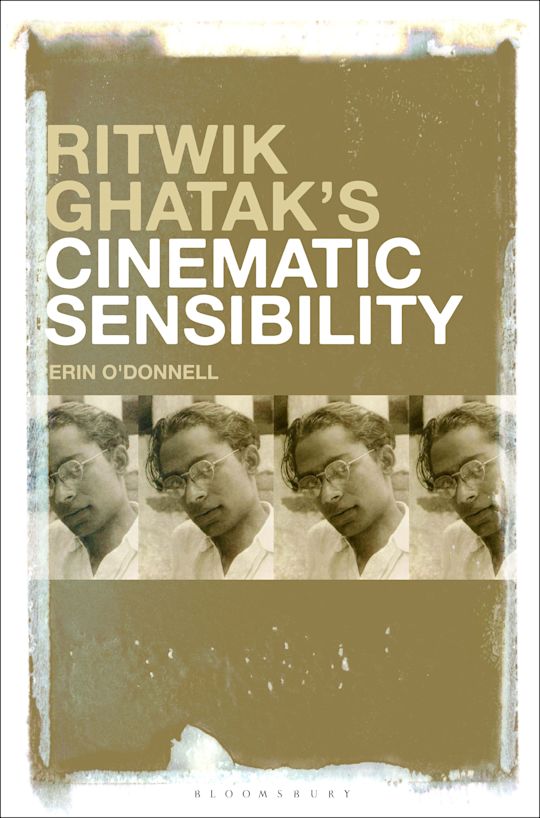


Ritwik Ghatak’s Cinematic Sensibility
Buying pre-order items
Ebook and audiobook pre-orders will be delivered on the publication date.
Payment for this pre-order will be taken when the item becomes available
Description
The Bengali filmmaker, Ritwik Kumar Ghatak (1925-1976), wrote, produced, directed and/or acted in plays, feature films and documentaries in Bengal during the socially and politically tumultuous period from the late 1940s through the mid-1970s. Why Ghatak? Within the contexts of Bengali, Indian and world cinema, Ghatak is considered an innovative, revolutionary master of the cinematic medium who possessed a singular cinematic sensibility. He composed numerous essays on film and filmmaking in English and Bengali. Dozens of interviews have been recorded that present an artist who was contemplative, outspoken, at times misunderstood, at turns obstinate and contradictory.
From his first film, Nagarik (“The Citizen,” 1953) through his final film, Jukti Takko ar Gappo (“An Argument, a Debate, and a Story,” 1974), Ghatak constructed detailed visual and aural filmic commentaries about modern Bengali culture and society. Twice during his lifetime Bengal was physically rent apart – in 1947 with the Partition of India engendered by the departure of the British and in 1971 by the Bangladeshi War of Independence. In Ghatak's films, the ambivalence and contradictions of Bengali society in post-1947, post-Partition, post-Independence India are pointedly portrayed. Against this frequently adverse milieu, Bengal's modern cultural memory, identity, and history are interrogated and continually reassessed in his cinema.
Accessibility Information
Additional accessibility information
- EPUB 3.0
- Conforms with the requirements of EPUB Accessibility Spec v1.1
- WCAG level AA
- WCAG v2.2 compliant
- accessibility@bloomsbury.com
Hazards
The publication contains no hazards
Support for non-visual reading
- No accessibility features offered by the reading system, device or reading software are disabled or otherwise unusable with the product
- Has alternative text descriptions for images
Visual adjustments
Appearance of the text and page layout can be modified according to the capabilities of the reading system (font family and size, spaces, as well as color of background and text)
Navigation
- Page list to go to pages from the print source version
- Elements such as headings, tables, etc for structured navigation
- All or substantially all textual matter is arranged in a single logical reading order
- Content is enhanced with ARIA roles to optimize organization and facilitate navigation
- Purposes of all links are made clear
Table of Contents
1: The Roots of Ritwik Ghatak's Cinematic Sensibility
2: The Indian People's Theater Association (IPTA) on Film: (Con)testing Memory and History in the Bengali Theaterscapes, Landscapes and Cityscapes of Komal Gandhar (“E Flat,” 1961)
3: The Exilic Sentiments and Journeying Impulses of Nagarik (“The Citizen,” 1953), Ajantrik (“The Unmechanical,” 1958), and Jukti Takko ar Gappo (“An Argument, A Debate and a Story,” 1974)
4: The Assemblage of “Woman” in the Affective Melodramatic Mode of Meghe Dhaka Tara (“A Cloud-Covered Star,” 1960) and Subarnarekha (“The Golden Line,” 1962)
5: The Reconciliation of “Home” and “Homeland” in Bari Theke Paliye (“Running Away From Home,” 1959) and Titas Ekti Nadir Naam (“A River Called Titas,” 1973)
Conclusion
Bibliography
Index
Product details

| Published | Mar 18 2027 |
|---|---|
| Format | Ebook (Epub & Mobi) |
| Edition | 1st |
| Pages | 224 |
| ISBN | 9781501359255 |
| Imprint | Bloomsbury Academic |
| Publisher | Bloomsbury Publishing |
Related Titles