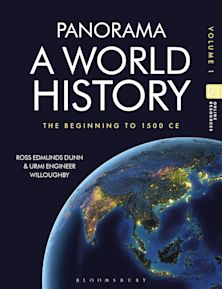
Panorama, A World History
Volume 2: 1450 to the Present
- Textbook

Panorama, A World History
Volume 2: 1450 to the Present
- Textbook
Description
How did the Columbian Exchange transform diets around the world? Why did expanding global trade hurt textile workers in India? In what circumstances did the COVID-19 virus become a global pandemic?
Panorama explores these questions by following the journey of humankind in a global context, weaving a world-scale narrative with a single chronological thread. It empowers you to connect the regional histories of particular states, empires, and cultural traditions to larger patterns of change on hemispheric and global scales-examining migratory movements, networks of trade, the spread of religions, pandemics, and environmental transformations.
Richly illustrated with 120 images and 48 maps, this new edition is organized into three chronological parts, each covering a defined era in world history. Volume 2 starts in the mid-fifteenth century CE and surveys up to the present day.
Each chapter includes dedicated learning features:
· “Individuals Matter” presents biographical sketches of individuals, both notable historical figures and ordinary people, whose lives in some way illuminate the chapter's main developments.
· “Weighing the Evidence” asks you to analyse and interpret primary sources, either texts or visual artifacts.
· “Thinking about the Past with Global and Comparative Themes” encourages you to examine the threads of change that cut across global space and time.
· “Thinking History” questions help consolidate your knowledge, and “Reflecting on the Past” questions invite you to contemplate broader chapter themes.
· In-margin definitions of words and phrases help you build key vocabulary.
With its unique global narrative, chronological storytelling and exceptional features, Panorama provides a clear framework to analyse and engage with the changes, continuities, and anomalies in our world's past-and their impact on the present.
Accessibility Information
Additional accessibility information
- EPUB 3.0
- Conforms with the requirements of EPUB Accessibility Spec v1.1
- WCAG level AA
- WCAG v2.2 compliant
- accessibility@bloomsbury.com
Hazards
The publication contains no hazards
Support for non-visual reading
- No accessibility features offered by the reading system, device or reading software are disabled or otherwise unusable with the product
- Has alternative text descriptions for images
Visual adjustments
Appearance of the text and page layout can be modified according to the capabilities of the reading system (font family and size, spaces, as well as color of background and text)
Navigation
- Page list to go to pages from the print source version
- Elements such as headings, tables, etc for structured navigation
- All or substantially all textual matter is arranged in a single logical reading order
- Content is enhanced with ARIA roles to optimize organization and facilitate navigation
- Purposes of all links are made clear
Table of Contents
Tour of the book
Online resources
About the Authors
An Interview with the Authors
Acknowledgements
PART 1 - THE GREAT WORLD CONVERGENCE 1450–1750
1. Oceans Crossed, Worlds Connected 1450–1550
On the Eve of the Great World Convergence
-Changes in the Afroeurasian Trade Network
-Europeans Looking East
-The Eastern Atlantic Rim
-States in the Americas
The Birth of the Atlantic World
-Changing Maritime Technology
-Europeans and Tropical Africans: Early Encounters
-Crossing and Connecting Oceans
American Catastrophes
-The Columbian Exchange and Pandemic Disease
-The End of the Aztec Empire
-Assault on the Inca Empire
-Building the Spanish Empire
-The Portuguese Claim to Brazil
New Power Relations in the Southern Seas
-To Capture the Spice Trade
-The Transpacific Link
Individuals Matter: Doña Marina: Translator, Diplomat, and Slave
Weighing the Evidence: Martin Behaim's Fifteenth-Century Globe
Global and Comparative Themes: Consequences of the Great World Convergence
2. Afroeurasia and Its Powerful States 1500–1600
States on the Rise in the Sixteenth Century
-The Ottoman Empire's Dramatic Growth
-The Safavid Empire of Persia
-Mughal Power in South Asia
-Russia: From Principality to Empire
-The Tokugawa in Japan
-Strong Monarchies in Southeast Asia
-The European States
-The Songhay Empire
Firearms and State Power
-New and Deadly Armies
-The Military Revolution
-The Limits of Central Power
Trends in Religion, Language, and Culture
-Intellectual and Moral Ferment in China
-Tension between Sunni and Shi'a Muslims
-Religious Crisis in Europe
-Vernacular and Prestigious Languages
Individuals Matter: Doña Gracia Mendes Nasi: A Sixteenth-Century Businesswoman
Weighing the Evidence: A European Ambassador Compares Armies
Global and Comparative Themes: The rise and fall of languages across time
3. The Expanding Global Economy: Expectations and Inequalities 1550–1700
Three Major Global Developments
-The Worldwide Network Takes Shape
-The Continuing Columbian Exchange
-Climate Change in the Sixteenth and Seventeenth Centuries
Afroeurasia and the Expanding World Economy
-Western Europe's Economic Thrust
-Centuries of Silver in East Asia
-Asians and Europeans in the Southern Seas
The Atlantic Economy: Land, Capital, and Slave Labor
-The Atlantic Economy and African Slavery
-Change in Atlantic Africa
Individuals Matter: Louis De Geer: A Capitalist Success Story
Weighing the Evidence: Servants and Slaves on a Barbados Sugar Plantation
Global and Comparative Themes: How much power did Europeans exercise in the world in the sixteenth and seventeenth centuries?
4. The Changing Balance of Wealth and Power 1600–1750
Empires and Big States
-Chinese Prosperity and Imperialism
-Russia from the Baltic to the Pacific
-The Spanish Empire in America
-Europe: The Aims and Limits of Absolutism
Encounters between Indigenous Peoples and European Settlers
-European Settlers Abroad
-Indians and Europeans in the North American Woodlands
-Russians and Siberians
-Europeans and Khoisan in South Africa
Alternative Visions of God, Nature, and the Universe
-Scientific Advances
-The Enlightenment: Rethinking Human Nature and Society
-The Continuing Growth of Islam and Christianity
Individuals Matter: Dona Beatriz Kimpa Vita: Visionary Christian of the Kongo
Weighing the Evidence: The Journal of a Dutch Commander at the Cape of Good Hope
Global and Comparative Themes: Types of colonial societies
PART 2 - THE MODERN WORLD TAKES SHAPE 1750–1914
5. Waves of Revolution 1720-1830
World Economy and Politics, 1720–1763
-A Commercializing World
-Troubled Empires in Asia
-Global Trade and the Eighteenth-Century “World War”
Revolutions around the North Atlantic Rim
-The Global Context of Popular Revolt
-The War of Independence in British North America
-The French Revolution
-The Birth of Haiti
-The Idea of Nationalism
The Second Wave: Revolutions in Latin America
-Colonial Society on the Eve of Rebellion
-The Wars of Independence
-Many Young States
Individuals Matter: José de San Martin: Liberator of the Southern Andes
Weighing the Evidence: Toussaint Louverture Writes to the French Directory
Global and Comparative Themes: Connected Revolutions
6. Energy and Industrialization 1750–1850
The Energy Revolution
-The Fuel That Lies Beneath
-The End of the Biological Old Regime
Industry on a New Scale
-Cotton and the Drift to Industrialization
-Mines and Machines
-Working in Factories
-Was There Something Special about Britain?
-Social and Environmental Consequences of Early Industrialization
Industrialization and Global Exchange in the Early Nineteenth Century
-The Energy Revolution Takes Hold
-The Threads of Commerce
-Free Trade and the New Doctrine of Liberalism
Individuals Matter: Ned Ludd: Legendary Foe of Industry
Weighing the Evidence: On Legalizing Opium in China
Global and Comparative Themes: The origins of the industrial revolution: what were the global circumstances?
7. Coping with Change in the New Industrial Era 1830–1870
Millions Migrating
-Nineteenth-Century Slave Trade
-The Outpouring from Europe
-Indigenous Peoples and Settler Colonies
-Migrations from Asia
-Oceania Connected
Groundswells of Political and Social Reform
-Nationalism and the Power of the People
-Varieties of Socialism
-Movements for Women's Rights
-Movements for Political Reform and Unification in Europe
-Modernizing Reforms in Muslim Lands
-The Limits of Liberalism in Latin America
Religion and Reform
-Global Trends and Religious Change
-Christian Evangelism
-Jewish Reform
-Religious Reform and Revolution in the Muslim World
Global Change and the Calamitous Wars of Mid-century
-The Crimean War and the Industrialization of Violence
-Paraguay: A War of Annihilation
-The Taiping Rebellion in China
-The Great Indian Rebellion
-Civil War in the United States
Individuals Matter: Ram Mohan Roy: Hindu Reformer
Weighing the Evidence: A Moroccan Diplomat in France
Global and Comparative Themes: Comparing characteristics of modernity
8. Capital, Technology, and the Changing Balance of Global Power 1860–1914
The Spread of Steam-Powered Industry
-Wealthy Britain
-Industrial Hubs in Continental Europe and the United States
-Smokestacks in Russia
-The Meiji Restoration and Japanese Industry
-Industrialization on Smaller Scales: Gains and Disappointments
Capitalism's Global Reach
-The Worldwide Communication Grid
-Feeding Industrial Societies
-Rich Regions, Poor Regions
-The Working Class and the Middle Class
-Globalizing Business, Technology, and Science
European Imperialism and Popular Resistance
-The Road to Colonialism in Africa and Southeast Asia
-Why Did European Invasions Succeed?
-Resistance Movements and Their Consequences
-States That Survived
Individuals Matter: Chulalongkorn: Modernizing Monarch
Weighing the Evidence: Contrasting Perspectives on War in East Africa
Global and Comparative Themes: Explaining imperial success in the late nineteenth century
PART 3 - THE PROMISE AND THE PERILS OF ACCELERATING CHANGE 1890–2024
9. Innovation, Revolution, and Global Crisis 1890-1920
Turn-of-the-Century Economic Growth, 1890-1914
-Commerce and Gold
-Urbanization and Migration
-Scientific and Technological Advances
Global Inequality and Its Consequences
-Drought and Plague
-Africa and Southeast Asia under New Colonial Rulers
-Worker Protest and Nationalist Ferment in Europe
-Five Revolutions
The Great War, 1914-1918
-Lighting the Fuse
-A World at War
-Total War
-Russia: From War to Revolution
-Peace and Consequences
Individuals Matter: Qiu Jin: Social Reformer
Weighing the Evidence: Arab Independence That Was Not to Be
Global and Comparative Themes: Was World War I really the first world war?
10. Turbulent Decades 1918-1935
Postwar Trends in Society and Culture
-Population Trends
-New Ways of Living in the Industrialized World
-Scientific Challenges to the Knowable Universe
-Modernity and Modernism
Clashing Political Ideologies
-Democratic Hopes
-The Soviet Union under Communist Party Rule
-Nationalists and Communists in China
-New Governments on the Political Right
-Left and Right in Latin America
Colonial Rule and Its Opponents in Africa and Asia
-Economy and Society in the Colonial Empires
-Ways of Ruling
-Immigrants to Colonized Lands
-Colonial Rule Contested
The Great Depression and Its Consequences
-The Steep Descent
-The Continuing Authoritarian Trend
Individuals Matter: Diego Rivera: Mexican Modernist
Weighing the Evidence: Turkish Views on Dress and National Identity
Global and Comparative Themes: The meaning of modernism
11. World War II and Its Aftermath 1933-1950
Empire Building and Global Crisis
-Empire of the Sun
-The Nazi State
-Italy's Foreign Aggressions
-Fascist Dictatorship in Spain
World War II
-The Years of Axis Victory, 1939–1942
-The Years of Counteroffensive, 1942–1945
-The Second Total War
-The War Beyond the Theaters of War
-The War and the Global Environment
In the Wake of War, 1945–1950
-Restoring Stability, Enforcing Justice
-The Two New Empires
-Challenges to Colonial Empires
-Communist Victory in China
Individuals Matter: Olga Lisikova: Soviet Combat Pilot
Weighing the Evidence: Propaganda for Wartime Conservation
Global and Comparative Themes: Comparing the two world wars: similarities, differences, and connections
12. The Global Boom and Its Contradictions 1945-1975
Population and Economy: An Era of Spectacular Growth
-Global Population at Its Crest
-The Postwar Economic Boom
-Economic Growth in Communist States
-The Worldwide Lure of Industrialization
-Cities, Suburbs, and Shantytowns
-Postwar Consumer Society
-The Biosphere in Distress
The Cold War Wears On
-The Era of Mutually Assured Destruction
-The Cold War around the world
Fights for Freedom and Justice
-Paths to Independence: Protest and Negotiation
-Paths to Independence: Insurgency and Revolution
-Struggles for Stability in Young States
-The Turbulent Middle East
-Vietnam between Civil War and Cold War
-High Expectations and Social Protest
Individuals Matter: Alexander Dubcek: Leader of the Prague Spring
Weighing the Evidence: Frantz Fanon on the Shortcomings of the National Bourgeoisie
Global and Comparative Themes: The changing map of empires
13. Countercurrents of Global Change 1970 to 2008
Countercurrents in the Global Economy
-The 1970s: An Economic Turning Point
-The Rise of Neoliberalism
-Neoliberalism Around the World
-Shifting Centers of Economic Power
-The Electronic Revolution
The Problem of Inequality
-Poverty in a Capitalist World
-Women in the World Economy
-International Migration
The Changing Political Order
-Interstate Relations and the End of the Bipolar Order
-United States Power Displayed
-Israel and Palestine: The Interminable Conflict
-The Role of International Organizations
-The Global Democratizing Trend After 1970
-War, Disorder, and Terror in an Era of Global Integration
Facing the Anthropocene
-Unintended Consequences
-Environmentalist Movements
Individuals Matter: Wangari Maathai: Environmental Activist and Nobel Laureate
Weighing the Evidence: Changing Views of the Chinese Economy
Global and Comparative Themes: The meaning of globalization
14. The World after the Great Recession 2008-2024
Climate Change, Disease, and Environmental Degradation
-The Perils of Global Warming
-Climate Change and Natural Disasters
-The Threat of Emerging Diseases
-Pollution and Threats of Biodiversity
-Pollution and plastics
-Disappearing species
The Neoliberal World Economy in Question
-The Great Recession
-Popular Protest
-The Long, Hesitant Recovery
-Recession Aftermath: China, the United States, and the European Union
-The COVID-19 Recession
-The Problem of Inequality
Global Politics
-Challenges to Democracy
-The Middle East and North Africa: Power Relations in Motion
-Tense Relations: The United States, Russia, and China
Global Prospects for Social Justice
-Social Justice for Indigenous Communities
-Racial Justice and Police Violence
-Social Justice for Women and Gender Minorities
-Rights for LGBTQ+ Communities
Individuals Matter: Winona LaDuke, Indigenous Activist
Weighing the Evidence: The Tahrir Square Moment
Good Reading list
Index
References
Product details

| Published | 19 Feb 2026 |
|---|---|
| Format | Ebook (Epub & Mobi) |
| Edition | 2nd |
| Pages | 592 |
| ISBN | 9781350434264 |
| Imprint | Bloomsbury Academic |
| Illustrations | 120 color illus |
| Publisher | Bloomsbury Publishing |


Reviews

Related Titles